


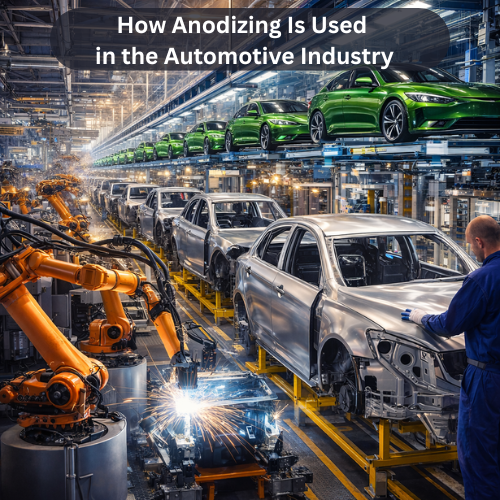
The automotive industry is undergoing a major material transformation driven by stricter emission norms, electrification, light weight requirements, and long-term durability expectations. Among surface engineering technologies, anodizing of aluminium has emerged as a critical process that enables automakers to meet performance, safety, and sustainability targets simultaneously.
Anodizing is no longer limited to decorative trims. Today, it plays a functional, structural, and protective role across powertrain components, chassis parts, electric vehicle systems, and exterior applications.
This article explores how anodizing is used in the automotive industry, covering the process, technical advantages, applications, and real-world use cases.
What Is Anodizing in Automotive Manufacturing?
Anodizing is an electrochemical surface conversion process in which aluminium acts as the anode in an electrolytic cell. When direct current is applied in an acidic electrolyte (commonly sulfuric or chromic acid), the aluminium surface is converted into a controlled aluminium oxide (Al₂O₃) layer.
Unlike paint or electroplating, this oxide layer is:
- Integral to the base metal
- Non-peeling and non-flaking
- Highly wear-resistant
- Porous before sealing, allowing colouring and functional treatments
In automotive engineering, this oxide layer provides mechanical protection, corrosion resistance, electrical insulation, and thermal stability without adding significant weight.
Why Aluminium Requires Anodizing in Vehicles
Aluminium is widely used in vehicles due to its:
- Low density (approx. one-third the weight of steel)
- High strength-to-weight ratio
- Good thermal conductivity
- Excellent recyclability
However, untreated aluminium has limitations:
- Susceptible to pitting corrosion in saline or acidic environments
- Limited surface hardness
- Poor wear resistance in moving or friction-heavy assemblies
Anodizing overcomes these limitations, making aluminium suitable for long-life automotive applications, including those exposed to heat, vibration, road salts, moisture, and UV radiation.
Automotive Anodizing Process – Technical Overview
The anodizing process used for automotive components follows a controlled, multi-stage sequence:
- Degreasing & Alkaline Cleaning
Removes oils, machining fluids, and contaminants. - Etching & Desmutting
Ensures uniform surface morphology and removes alloying residues. - Electrochemical Anodizing
Aluminium is oxidized under controlled voltage and current density to form a porous oxide layer. - Optional Colouring (Electrocolouring or Dip Dyeing)
Used for black, bronze, grey, or aesthetically pleasing multi-colored finishes. - Sealing (Hot or Cold Sealing)
Hydrates and closes pores to enhance corrosion resistance and colour stability.
For automotive use, process parameters such as oxide thickness, hardness, porosity, and sealing quality are tightly controlled to meet performance specifications.
Types of Anodizing Used in the Automotive Industry
1. Sulfuric Acid Anodizing (Type II)
- Oxide thickness: ~5–25 microns
- Used for:
- Exterior trims
- Interior components
- Decorative and functional parts
2. Hard Anodizing (Type III)
- Oxide thickness: ~25–100 microns
- High microhardness (up to ~500 HV)
- Used for:
- Pistons
- Brake components
- Gearbox housings
- Sliding and wear-critical parts
3. Chromic Acid Anodizing (Type I)
- Thin but highly corrosion-resistant
- Used where dimensional tolerance is critical
Automotive Components That Use Anodized Aluminium
Anodizing is widely applied across vehicle systems:
Powertrain & Mechanical
- Pistons
- Cylinder heads
- Transmission housings
- Gearbox components
- Anti-lock braking system (ABS) parts
Chassis & Structural
- Suspension components
- Frames and cross members
- Mounting brackets
Exterior & Interior
- Wheels and wheel hubs
- Trims and decorative panels
- Roof rails and handles
Electric Vehicle Systems
- Battery enclosures
- Inverter housings
- Power electronics casings
Thermal management components
Why Anodizing Is Critical for Electric Vehicles (EVs)
Electric vehicles place higher functional demands on materials:
- Electrical insulation around high-voltage systems
- Thermal stability for battery and power electronics
- Lightweight structures to increase driving range
- Fire and corrosion safety
Anodized aluminium meets these requirements by:
- Acting as a dielectric barrier
- Retaining thermal conductivity of aluminium
- Withstanding temperature cycling
- Offering long-term corrosion resistance without coatings that degrade
Performance Advantages Over Paint and Electroplating
| Property | Anodizing | Paint | Electroplating |
| Adhesion | Integral to metal | Surface-level | Surface-level |
| Wear resistance | High | Low–Medium | Medium |
| Peeling risk | None | High | Moderate |
| Weight addition | Negligible | Moderate | Higher |
| Environmental impact | Low | VOCs | Heavy metals |
Anodizing is particularly suited for high-volume automotive manufacturing where consistency, durability, and sustainability are critical.
Environmental and Sustainability Benefits
Anodizing aligns with automotive sustainability goals:
- No VOC emissions
- Low sludge generation (with modern chemistries)
- Fully recyclable aluminium substrate
- Long service life reduces part replacement
- Lower lifecycle environmental footprint
This makes anodizing ideal for OEMs transitioning toward green mobility and circular manufacturing.
Real-World Automotive Use Examples
- Performance vehicles use hard anodized pistons and brake components to withstand high friction and heat.
- Electric vehicles rely on anodized battery frames and housings for electrical insulation and corrosion protection.
Premium vehicle interiors and exteriors use black or natural anodized aluminium trims for fingerprint resistance and long-term aesthetics.
Conclusion
Anodizing has evolved into a critical surface engineering technology for the automotive industry. By enhancing durability, wear resistance, corrosion protection, and electrical properties of aluminium without compromising weight, anodizing enables modern vehicles to meet demanding performance, safety, and sustainability requirements.
As automotive platforms continue to shift toward electrification, lightweight structures, and extended service life, anodized aluminium will remain a foundational material solution, not just for aesthetics, but for core vehicle performance.
Frequently Asked Questions – FAQs
1. How can I get in touch with your team for Anodizing requirements?
You can contact us directly by emailing corporatecommunications@growel.com. Our team will be happy to assist you with your specific requirements, technical questions, or service inquiries.
2. Is there any inquiry form that I need to fill out?
Please visit our Anodizing Solutions page. Scroll to the bottom of the page — you’ll find a simple inquiry form there. Kindly fill it out, and our team will contact you shortly to assist with your requirements.
3. Is there a support email if I have questions about the website or technical issues?
Yes! For any queries related to Anodizing, please reach out to corporatecommunications@growel.com. We’ll ensure your query is resolved promptly.